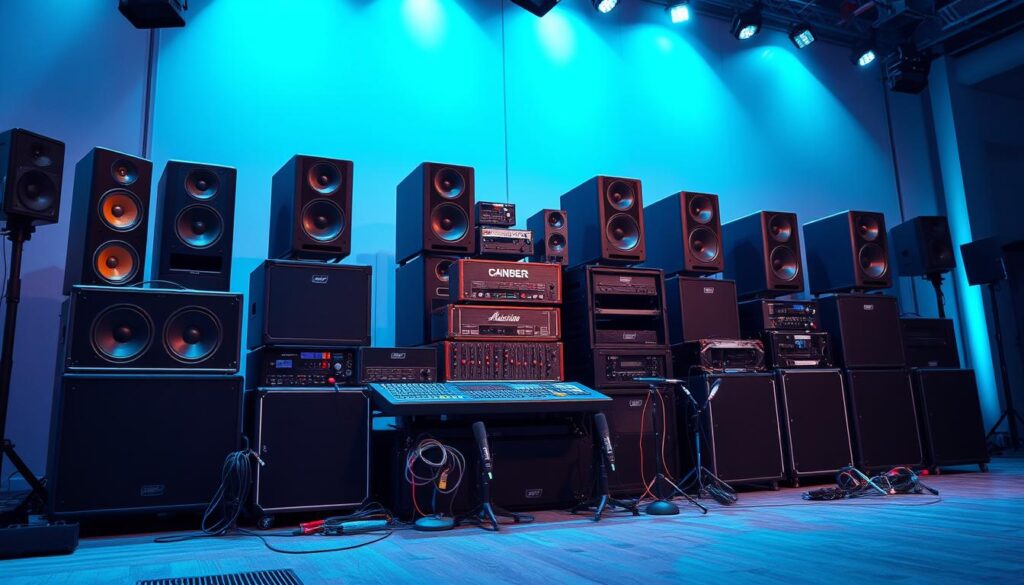
Warehouse and workshop audio must be planned for noise, distance, dust, equipment movement, and safety. Standard speakers may work in a small office or retail room, but they often fail in industrial spaces. The problem is not only volume. The system must stay clear, reliable, and usable in difficult conditions.
Commercial audio speakers used in these spaces should be selected for coverage, durability, mounting position, and speech clarity.
Check The Noise Level First
Start with the normal noise level of the space. Do not test the area when it is empty and quiet. Check it during real operations.
Common noise sources include forklifts, machinery, compressors, tools, fans, loading doors, vehicles, and staff movement. These sounds can cover music and announcements. If the system is not planned correctly, staff may hear sound but not understand it.
Speech clarity is more important than loudness. A loud announcement that cannot be understood is not useful.
Do Not Use Office Speakers For Industrial Areas
Office speakers are usually made for controlled indoor environments. Warehouses and workshops are different. They may have dust, vibration, high ceilings, wide open spaces, temperature changes, and hard reflective surfaces.
A standard speaker may not project sound far enough. It may also be difficult to hear once machines are running. In some spaces, the speaker may need a stronger enclosure, better mounting hardware, or a more focused sound pattern.
This is where commercial audio speakers must be matched to the conditions of the building, not chosen only by price or appearance.
Plan For Height And Distance
Many warehouses have high ceilings. Sound from ceiling-mounted speakers can spread too widely before reaching the listener. This can reduce clarity and create echo. In some cases, wall-mounted or directional speakers may work better.
Large spaces may need several speaker zones. A loading bay, packing area, workshop floor, office corner, and staff break area should not always use the same volume level. Each area has different noise and coverage needs.
Do not solve distance problems by increasing the whole system volume. This can make one area too loud while another area remains unclear.
Protect Announcements And Safety Messages
Warehouses and workshops often need paging, shift updates, delivery calls, emergency messages, or staff instructions. These messages must be easy to hear in the correct areas.
Music quality is secondary if the system also supports announcements. The system should allow speech to cut through background noise without becoming harsh. Microphone levels, speaker placement, and zoning must be tested together.
Commercial audio speakers should support clear communication during normal work, not only during a quiet test.
Consider Dust, Moisture, And Impact Risk
Industrial spaces can be rough on equipment. Speakers may be exposed to dust, moisture, heat, cold, vibration, or accidental impact from tools, stock, or vehicles. The installation should account for these risks.
Check the speaker rating, mounting method, cable protection, and service access. Avoid placing speakers where they can be hit by forklifts, ladders, stock movement, or overhead equipment.
A system that is difficult to service will become a problem later. Plan access before installation.
Test With Workers In Place
After installation, test the system during real work conditions. Stand where employees actually work. Check areas near machines, benches, loading doors, storage racks, and walkways.
Test both music and announcements. Ask whether instructions are clear, not only whether sound is audible. Walk between zones and check for sudden volume changes, echo, and dead areas.
Commercial audio speakers in warehouses and workshops must be practical. They must cover large areas, handle difficult conditions, and support communication. Standard speakers may produce sound, but that is not enough. Industrial spaces need a system that remains clear, controlled, and reliable during the workday.