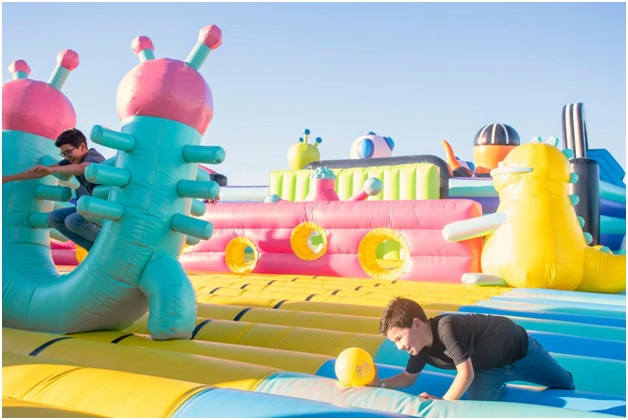
In busy environments where messages compete for seconds of attention, inflatable advertising stands apart through scale, movement, and colour. From outdoor promotions to temporary events, these structures influence how people notice, remember, and engage with a brand message—often before any text is read.
In today’s visually saturated environments, brands need more than static signage to stand out. Inflatable advertising achieves this by combining size, shape, and motion into a single visual statement. A giant inflatable ball placed within a promotional setting immediately alters sightlines, draws the eye, and signals presence from a distance—often before audiences consciously register traditional signage.
Inflatables work not because they shout louder, but because they interrupt visual routines. Their unusual form and scale break patterns that people have become accustomed to ignoring. Understanding why this works helps marketers use inflatable advertising more strategically and effectively.
Why Visual Attention Is Hard to Capture Today
Modern audiences process thousands of visual stimuli daily. As a result, selective attention filters out anything perceived as familiar or low-impact.
Visual Fatigue and Banner Blindness
Repeated exposure to flat posters and standard displays has reduced their effectiveness. Research in visual cognition suggests that people increasingly ignore rectangular, static formats because they resemble background clutter rather than meaningful signals.
The Need for Pattern Disruption
Objects that differ in scale, shape, or behaviour from their surroundings are more likely to trigger attention. Inflatable advertising introduces three disruptions at once:
- Uncommon proportions
- Soft, rounded geometry
- Subtle motion from airflow or wind
These elements reset visual focus in ways static media cannot.
The Psychology Behind Inflatable Advertising
Inflatables succeed because they align with how the human brain prioritises visual information.
Size as a Primary Attention Cue
Larger objects naturally command more attention. Vision science shows that scale is processed before detail, meaning people notice big things first and assess meaning second. Inflatable structures leverage this instinctive response, ensuring visibility even in crowded environments.
Movement and Peripheral Awareness
Even minimal movement attracts attention. Inflatable surfaces respond to air pressure and environmental airflow, creating gentle motion that is easily detected in peripheral vision. This keeps the display noticeable without appearing aggressive or distracting.
Novelty and Memory Encoding
Unusual objects are easier to remember. When viewers encounter an unexpected format—such as an oversized inflatable shape—the brain is more likely to store the experience, increasing recall of the associated brand message.
How Inflatable Forms Guide Visual Flow
Inflatable advertising does more than attract attention; it also helps guide how the eye moves across a space. Rounded and spherical forms encourage smoother, more natural eye movement than sharp-edged designs. A giant inflatable ball, for example, draws the gaze around its surface, holding visual attention for longer and creating a more engaging viewing experience than flat or rigid displays.
The use of bold, uninterrupted colour further supports this effect. Inflatable forms often rely on strong colour contrast without added visual complexity, which reduces cognitive effort for the viewer. This allows the message to be absorbed quickly and helps audiences associate the form with a brand identity without needing to read detailed text or process multiple visual elements.
Visibility Across Distances and Angles
One of the practical strengths of inflatable advertising is its adaptability to different viewing conditions.
Long-Range Recognition
Inflatables remain legible from afar because their message is often communicated through form and colour rather than fine detail. This makes them effective in large spaces where traditional signage loses impact.
Multi-Angle Effectiveness
Unlike banners or boards designed for a single viewpoint, inflatables maintain presence from multiple angles. Their three-dimensional structure ensures consistent visibility as audiences move through a space.
Strategic Advantages Over Traditional Displays
Inflatable advertising offers several functional advantages that go beyond simply capturing attention. One of the most practical benefits is speed of deployment. Inflatables can be installed and removed quickly, without the need for permanent fixtures or structural alterations. This makes them well suited to temporary promotions, short-term events, and environments where layouts may change frequently.
They also deliver strong visual impact without creating visual noise. By relying on shape, scale, and presence rather than dense messaging, inflatable displays remain easy to process at a glance. Viewers can recognise and register the display without feeling overwhelmed, resulting in high visibility paired with low informational friction.
Practical Tips for Maximising Visual Impact
To use inflatable advertising effectively, design and placement decisions matter.
Key considerations include:
- Choose simple shapes that contrast with the surrounding environment
- Use limited, high-contrast colours for instant recognition
- Position inflatables where natural sightlines converge
- Ensure scale matches the size of the space to avoid visual imbalance
- Keep branding minimal to support quick visual processing
These choices help inflatables remain striking rather than distracting.
Conclusion
Inflatable advertising attracts visual attention by working with human perception rather than against it. Through scale, motion, and novelty, it interrupts visual routines and creates memorable impressions without relying on complex messaging. When designed thoughtfully, a giant inflatable ball becomes more than a display—it becomes a visual anchor that holds attention, supports recall, and enhances brand presence in crowded environments.